
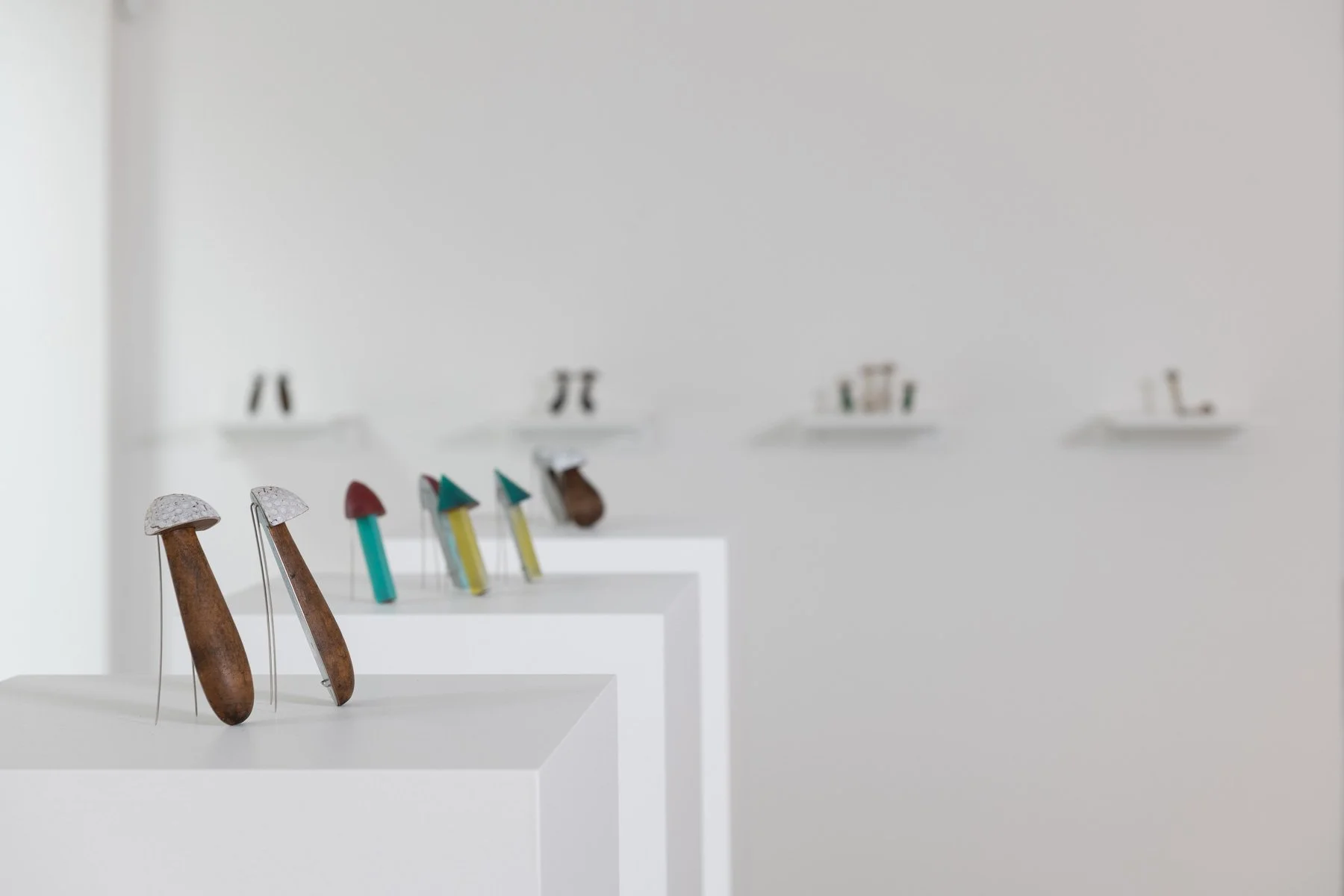


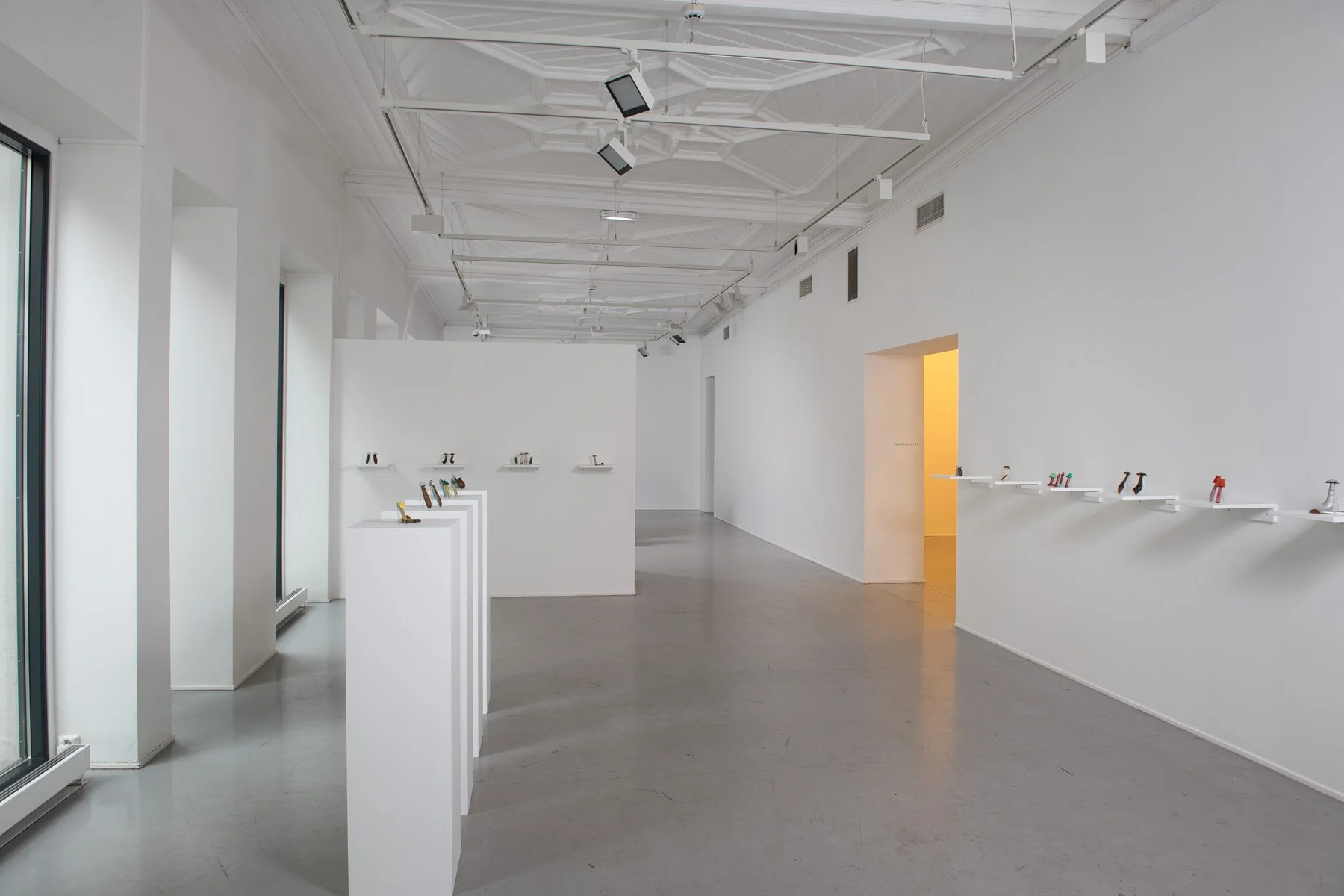
In the exhibition Mycelium of Things, Spillmann presents a selection of brooches created from objects found in forests while foraging for mushrooms. When he roams the woods in search of mushrooms, Spillmann often encounters unexpected remnants of human activity such as abandoned coffee kettles, plastic fragments, tools, golf balls, ski poles, lighters, and shotgun shells. Each of these discarded objects was once invented, designed and acquired for a specific purpose before being lost, abandoned, or deliberately left behind in the woods. The objects carry stories of their own. Over time, the forest transforms the surfaces of these objects. Exposure to weather, microorganisms, and the passage of time alters each one differently, depending on the material from which it is made and the length of its stay in the forest.
Teak wood from a coffee table and zinc-plated iron sheets found at garbage dumps in the city are used to transform the objects into functional brooches without changing the material’s surface. By crafting these discarded artefacts of civilisation into brooches inspired by mushrooms, Spillmann gives them new form and context. The transformation suggests new stories while inviting reflection on humanity’s place within a larger ecological system. Mushrooms are merely the visible fruiting bodies of fungi. Most of the organism exists as a hidden, thread-like network of mycelium, which may break down dead organic matter, or form symbiotic relationships with plant roots, or in some cases act as a parasite deriving nourishment from living organisms. Through these different modes of existence, fungi circulate nutrients and shape ecosystems.
Philipp Spillmann (b.1977 Zurich, Switzerland) lives and works in Oslo. He completed a traditional apprenticeship as a goldsmith at the Zurich School of Arts and Crafts. Spillmann works primarily with jewellery as an art form. In recent years, he has worked with public commissions for Fagerlundtunet Residential Care and Activity Centre in Sortland, Stord Upper Secondary School, Narvik Fire Station, Alta Care Centre, and Trudvang Kindergarten. Spillmann has exhibited nationally and internationally. He has participated in the Norwegian Associations for Crafts Artist´s Annual Exhibition and has held solo exhibitions at Telemark Art Centre, Gallery Four in Gothenburg, RAM Gallery and Østfold Art Centre. His works are included in the collections of the Museum of Applied Arts Cologne in Köln, The Design Museum in Munich, MUDAC – Museum of Contemporary Design and Applied Arts in Lausanne, Rian Design Museum in Falkenberg, the Northern Norwegian Art Museum, KODE and the National Museum of Norway.
The exhibition is supported by Arts Council Norway and The Art Centers in Norway (KiN).